During the Resistance War against the Americans and the Building Up of Socialism (1954-1975), numerous famous Vietnamese artists emerged and made significant contributions to the art scene. This period witnessed the rise of exceptional talents who left a lasting impact on Vietnamese art.
In the North, artists from the renowned Indochina College of Fine Arts played a crucial role in shaping the artistic landscape. Notable figures such as Tran Van Can, Nguyen Phan Chanh, Nguyen Tien Chung, and Nguyen Thi Kim were among the famous Vietnamese artists who showcased their immense talent and creativity. Their artworks captured the spirit of the nation’s struggle for independence and depicted the realities of war and revolution.
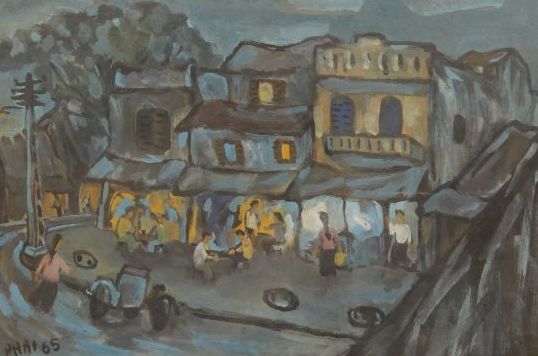
However, the most outstanding and influential artists from this period were three individuals from the last batch of the Indochina College of Fine Arts: Nguyen Sang, Nguyen Tu Nghiem, and Bui Xuan Phai. These extraordinary artists surpassed the confines of the Indochina style and developed their own unique artistic approaches. They skillfully combined traditional and modern elements, leaving a profound impact on later generations of Vietnamese artists.
In addition to these renowned artists, a generation of painters and sculptors emerged in the North during wartime. Artists like Trong Kiem, Tran Luu Hau, Van Da, and Quang Tho, along with sculptors such as Die Minh Chau, Nguyen Hai, and Le Cong Thanh, added depth and diversity to the Vietnamese art scene with their remarkable skills and artistic vision.
Vietnamese Artists Shaping History in the South during Turbulent Times
In the South, famous Vietnamese artists also made their mark. In the liberation region, artists such as Le Lam, Huynh Phuong Dong, and Thai Ha depicted the warfront and the bravery of soldiers through their authentic sketches. They created woodcut prints and captivating propaganda paintings that exuded revolutionary optimism, contributing to the spirit of the struggle.
Meanwhile, in the temporarily occupied region with Saigon as its center, the first generation of artists from the Indochina College of Fine Arts returned to their homeland. Figures like Nguyen Gia Tri, Le Van De, Pham Tang, Nguyen Khoa Toan, and Do Dinh Hip formed the backbone of the South’s art scene. Their adherence to traditional, classical, and somewhat conservative styles of art left a lasting impression on Vietnamese art during that time.
Reshaping Vietnamese Artistic Language in the Late 1950s and Early 1960s
As the late 1950s and early 1960s unfolded, a wave of artists advocating for a change in the language of art emerged. Artists like Duy Thanh, Ngoc Dung, Thai Tuan, and Ta Ty embraced a modern painting style and pushed the boundaries further. They paved the way for the Union of Young Artists of Vietnam (1967-1975) in formulating the language of art. This union included famous Vietnamese artists such as Nguyen Trung, Nguyen Phuoc, Do Quang Em, Nghieu De, Cu Nguyen, Nguyen Khai, Ho Huu Thu, Mai Chung, Dinh Cuong, and Trinh Cung. They integrated and adapted influences from art movements such as cubism, surrealism, and abstractionism, propelling Vietnamese art to new heights.
Regrettably, after 1975, some of these famous Vietnamese artists were forced to leave their homeland due to personal and political circumstances, resulting in a disruption of their creative activities. Nonetheless, their contributions remain an integral part of Vietnam’s rich artistic legacy.